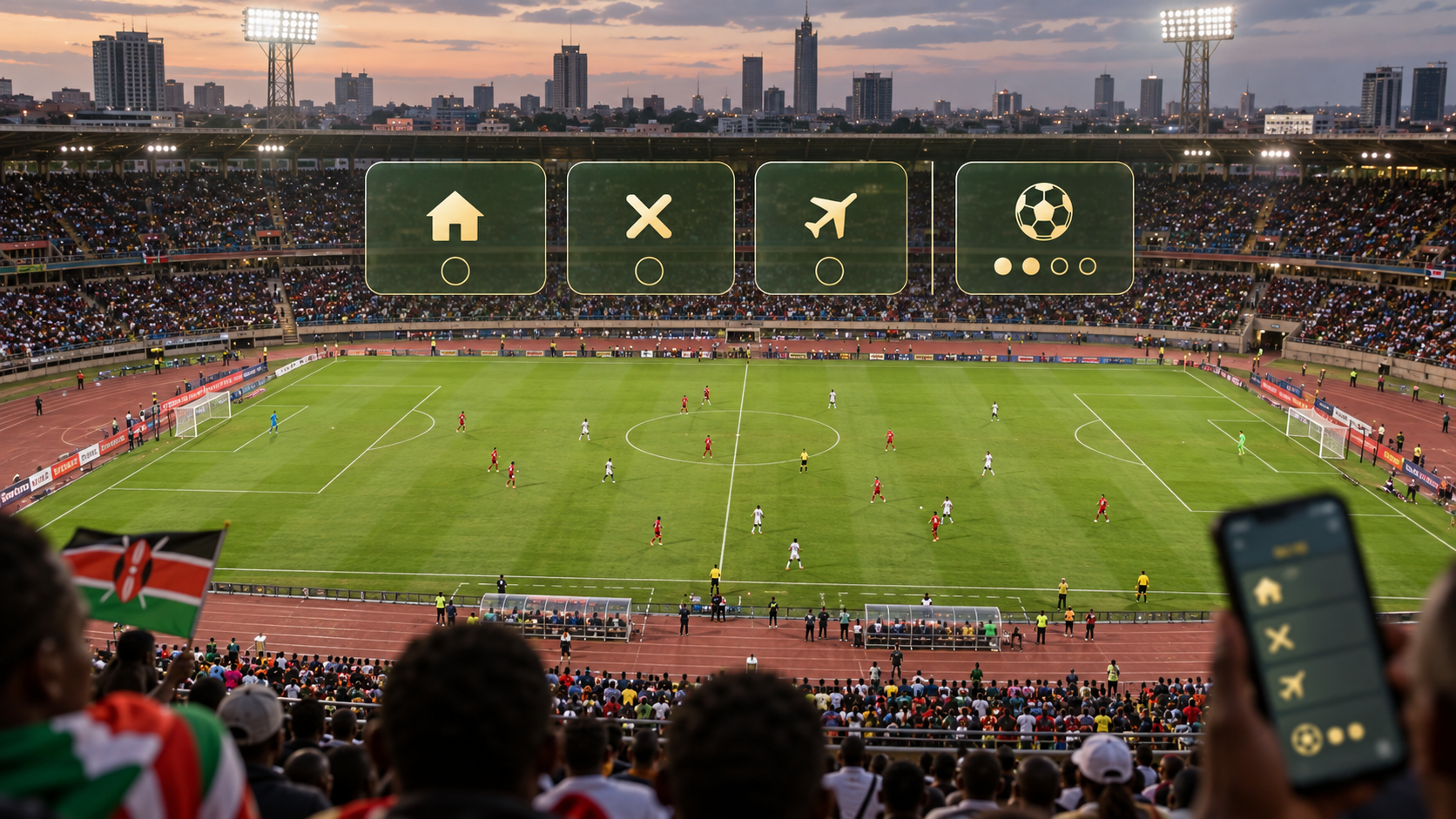
Decode the three symbols
For many standard football markets, the stated period is regulation time and stoppage time; extra time and penalties are excluded unless the market rules say otherwise. Always check the operator’s event and settlement wording instead of assuming a format.
“Home” and “away” refer to the teams as designated for that fixture. At neutral venues or in tournament formats, do not assume the first-listed team has the usual home advantage; the symbol still follows the market designation.
| Symbol | Selection | If the event settles |
|---|---|---|
| 1 | Home win | The designated home team wins within the market’s stated period |
| X | Draw | The match is level at the end of the stated period |
| 2 | Away win | The designated away team wins within the market’s stated period |
Why the draw is a separate outcome
In a three-way 1X2 market, a draw is neither a home win nor an away win. If the match finishes level within the covered period, a home-win or away-win selection usually loses under the standard definition. Other markets, such as draw-no-bet, may treat a draw differently, but they are not the same market.
The decimal odds for home, draw and away can be used in the margin calculator. Include all three prices from the same market snapshot to estimate raw implied probability and overround.
Check the slip carefully
A bet slip with “1” can be easy to misread if you have multiple fixtures open. Match the selection to the event row before confirming.
- Confirm the fixture and which team is listed as home.
- Check that the market says 1X2 or match result, not a related market.
- Read whether the selection covers regulation time only.
- Review the price, stake and acceptance confirmation.
A numerical illustration
Suppose a made-up 1X2 market shows decimal prices 2.20 for home, 3.10 for draw and 3.60 for away. The raw implied percentages are approximately 45.45%, 32.26% and 27.78%, which sum to about 105.49%. The excess above 100% is the overround in this simple calculation.
Those numbers do not forecast the match and do not account for how the operator allocates margin. The event example is hypothetical; no team or competition is being recommended.